The refractive cataract surgeon of the future wasn’t born with a new technology. They were born with a new way of thinking.
There was a time when the success of cataract surgery was extraordinarily easy to define. If the clouded lens disappeared, vision improved, and the patient could once again live independently, we had accomplished our mission.
For decades, that paradigm worked. And it worked so well that cataract surgery became one of the most successful procedures in all of medicine.
When the patient changes, the surgeon changes
Yet something began to change. It didn’t happen inside the operating room. It happened outside of it.
The patient changed.
And when the patient changes, the surgeon inevitably has to change as well.
Today it is almost impossible to understand modern surgery if we keep looking only at the eye. We have to look at the person. Their lifestyle. Their profession. Their habits. Their expectations. The way they use their vision from the moment they wake up until the end of the day.
The real question is no longer how well you see, but how you want to live
Because the question is no longer simply how much a patient sees after surgery.
The real question is how they want to live after surgery.
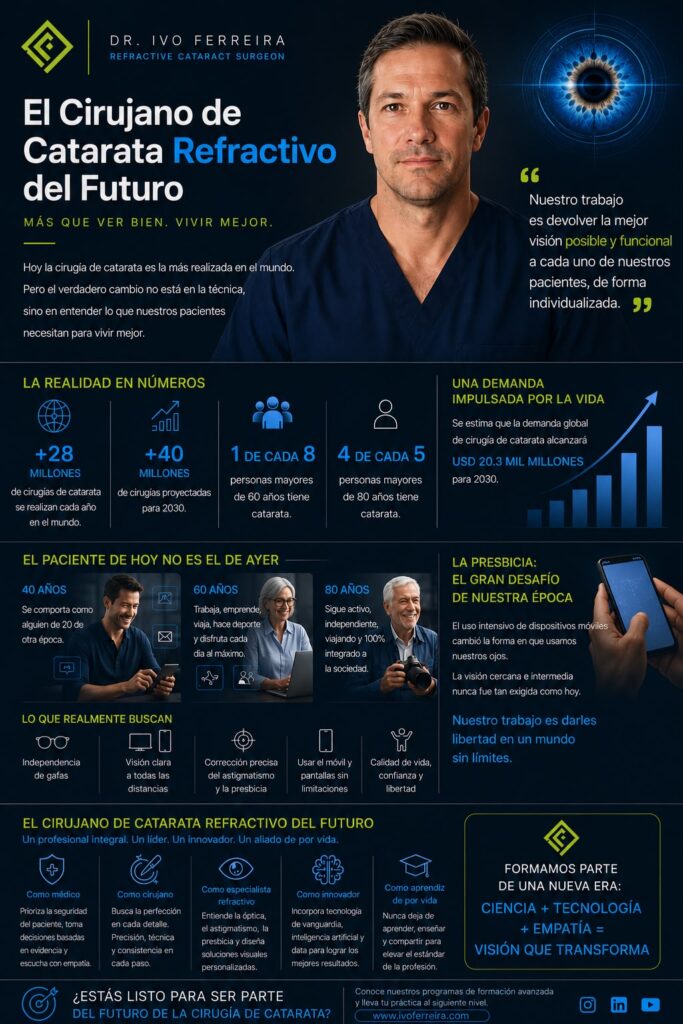
Twenty years ago, a sixty-year-old patient hoped to go back to reading the newspaper and watching television. Today that patient probably works, runs a company, cycles, travels several times a year, uses three screens throughout the day, and talks to their grandchildren over video calls. Even many eighty-year-old patients maintain an extraordinarily active social, professional, and intellectual life. They don’t feel they are closing a chapter. In many cases, they feel they are still building one.
Medicine has extended life expectancy. Society has extended active life.
And ophthalmology has a responsibility to accompany that transformation.
From restoring transparency to redesigning visual quality
That is why cataract surgery is no longer solely a surgery to restore transparency to the lens. Today it represents a unique opportunity to redesign the visual quality with which a person will live the next twenty or thirty years of their life.
That shift in perspective changes absolutely everything.
It is no longer enough to remove a cataract flawlessly. Today we must understand the impact of astigmatism, the importance of intermediate vision, the enormous weight that presbyopia carries in a society that lives connected to a screen and, above all, understand that freedom from glasses is no longer a luxury reserved for a few. For many people it means independence, productivity, and freedom.
Vision for a society connected to the screen
Few technologies have changed our relationship with vision as much as the smartphone. Never before had humanity used near and intermediate vision for so many hours a day. We work from a screen, we learn from a screen, we shop from a screen, and we maintain our personal relationships from a screen. The functional vision of the 21st century can no longer be defined solely by the ability to read the last line of an eye chart.
We need vision that keeps pace with real life.
A new kind of surgeon
And that demands a new kind of surgeon.
I am not talking only about someone capable of implanting a premium lens or mastering a more sophisticated technological platform. I am talking about a professional who combines science, engineering, psychology, communication, optics, technology, and a deeply human understanding of what it means to give back quality of life.
The refractive cataract surgeon of the future understands that every decision begins long before entering the operating room. It begins by listening. By discovering what that patient truly expects. What activities they enjoy. What worries them. What they are not willing to give up. Only then do they design a personalized surgical strategy.
The more technology advances, the more the human element matters
Paradoxically, the more technology advances, the more important the human component becomes.
Artificial intelligence will be able to help us plan surgery better. Biomarkers will make our decisions more precise. Simulators will allow us to train with an objectivity unthinkable just a decade ago. Robotics will continue to increase precision. All of that will happen. In fact, it is already happening.
But no technology will replace the ability to look a person in the eye and understand what they hope to recover when they say: “Doctor, I want to see well again.”
Training professionals, not just surgeons
Perhaps that is the greatest transformation we are living through.
For many years we trained excellent surgeons. Today we must train professionals capable of integrating multiple disciplines around a single person: the patient.
That means mastering surgery, of course. But it also means understanding optics, refraction, communication, data analysis, simulation-based training, continuous learning, and new technologies. It means accepting that excellence no longer depends solely on accumulated experience, but also on the ability to keep learning throughout one’s entire professional life.
Many of these skills still occupy a small space within traditional training. Not because they have stopped being important, but simply because they belong to a new generation of challenges that our specialty began to face relatively recently.
A paradigm shift
We are witnessing a paradigm shift.
We are not merely redefining a surgical technique.
We are redefining what it means to be an excellent cataract surgeon.
From a cataract to a life project
In my work training colleagues from different countries, I have seen that the real leap does not happen when someone learns a new surgical maneuver. It happens when the way they understand their patients changes. When they stop thinking about a cataract and begin to think about a life project. When they understand that every intraocular lens represents thousands of sunrises, millions of conversations, countless family photographs, trips, books, screens, and everyday moments that the patient will get to enjoy again.
That transformation does not depend on a machine.
It depends on a mindset.
And that is probably the most important competency we will need to develop over the next twenty years.
Because the future of cataract surgery does not belong to those who simply add more technology.
It belongs to those who learn to use that technology to better understand people.
That, in essence, is the true meaning of becoming a Refractive Cataract Surgeon of the Future.